Every install you do keeps its full 10-year warranty.

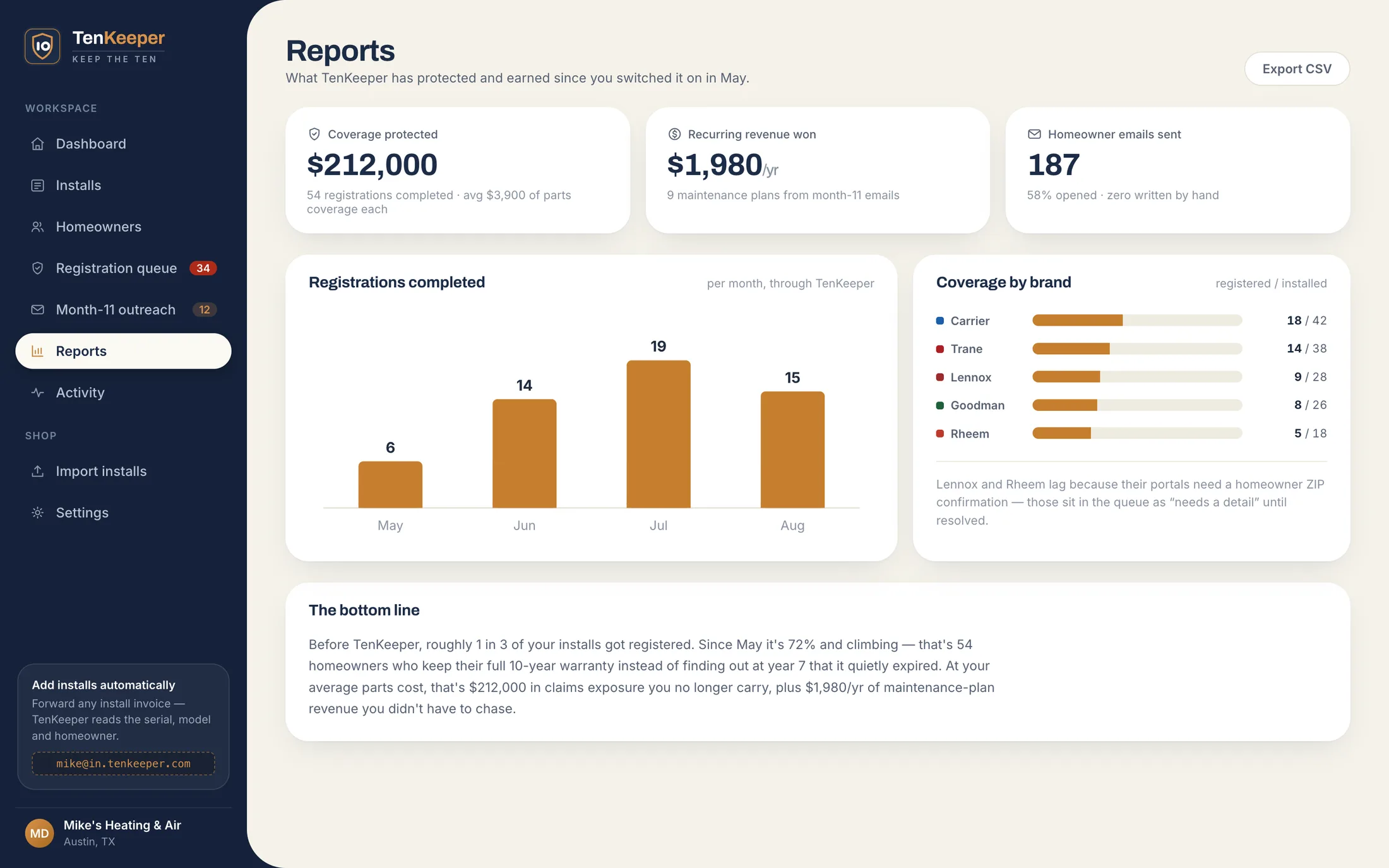
Most systems never get registered with the manufacturer — so the parts warranty quietly drops from 10 years to 5. When the compressor dies in year 7, the homeowner pays thousands out of pocket, and the review lands on your Google page. TenKeeper is a simple tool for HVAC shops that makes sure that never happens.

Early access · free for founding shops · no card, no call
tenkeeper.com
TenKeeper dashboard showing 152 installs tracked, 34 units at risk of losing their 10-year warranty, $84,200 of coverage at stake, and a registration rate climbing from 31% to 72%.

The Quiet Leak

38%
of installed units ever get registered

the rest silently lose half their coverage

Year 7
when it surfaces

a failed compressor, no coverage, $2,000–$3,500 out of the homeowner's pocket

Your name
on the review

homeowners blame the installer, not the paperwork

The form takes five minutes. Nobody's job is to remember it. That's the whole problem.

What TenKeeper Does

The warranty back office your shop never hired.

Six jobs, handled end to end — from the moment an invoice exists to the moment the homeowner renews a maintenance plan. Your office reviews and clicks; TenKeeper remembers, fills, chases, and files.

Invoices become install records

Forward any install invoice to your TenKeeper address and it reads the serial, model, install date, and homeowner — no re-typing. Housecall Pro, Jobber, and QuickBooks connections pull new jobs in automatically, and a CSV upload brings in your backlog.

Every registration window, tracked

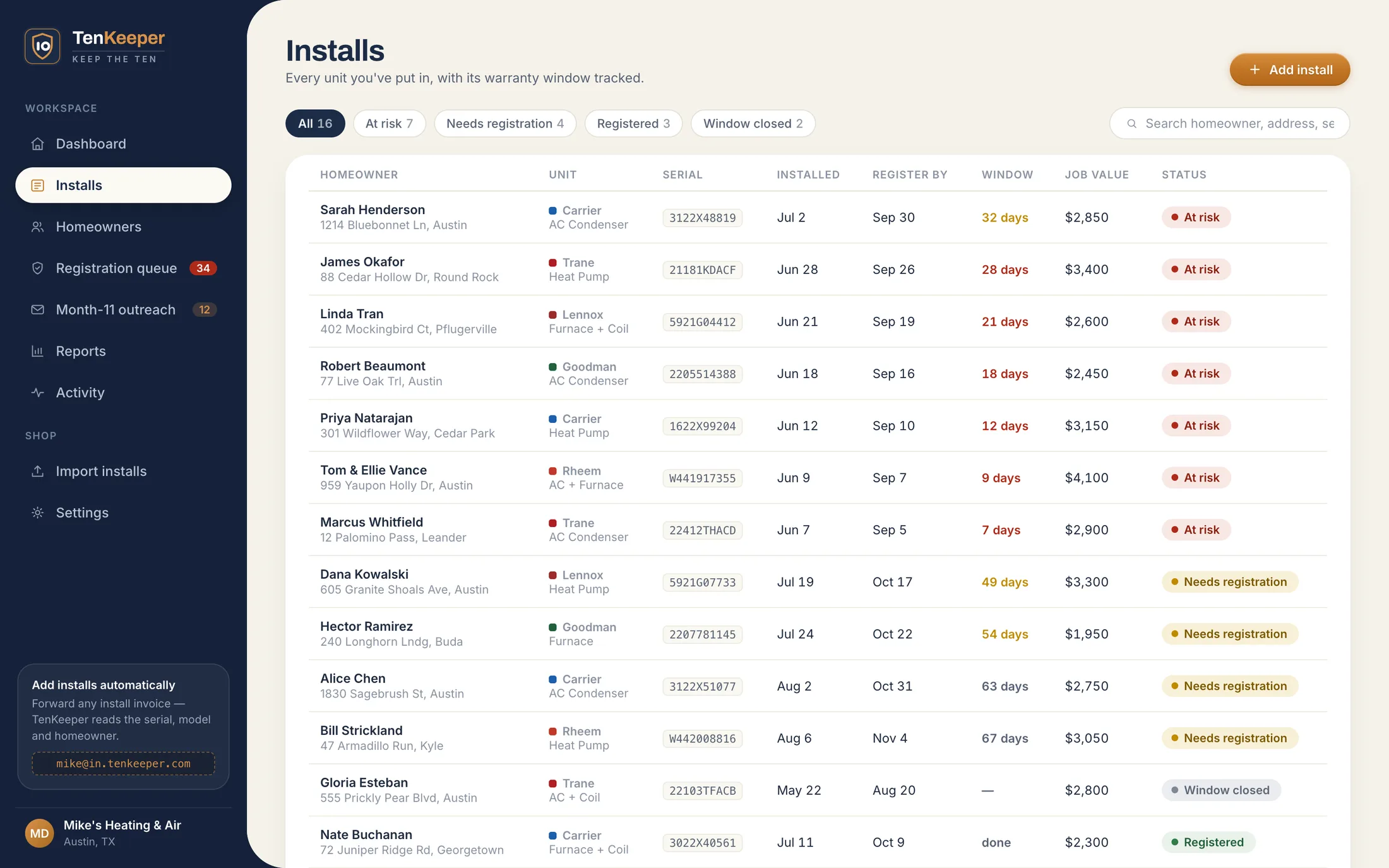
Each manufacturer gives you roughly 60–90 days to register before coverage drops. TenKeeper starts that clock on every unit, sorts the queue by deadline, and flags anything inside 60 days — so nothing quietly expires while the office is busy.

Manufacturer forms, pre-filled

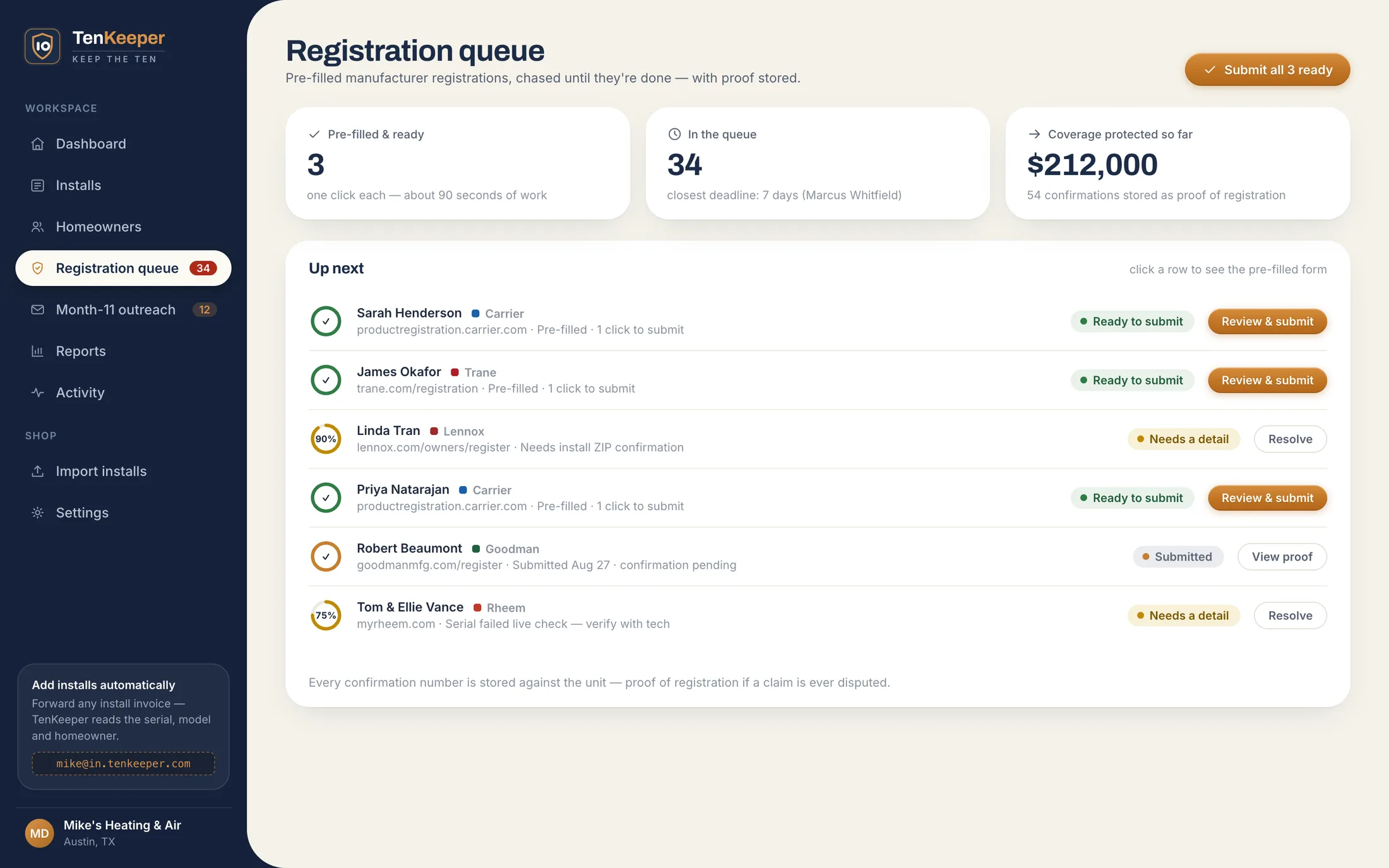
Carrier, Trane, Lennox, Goodman, and Rheem each want the same facts on a different form. TenKeeper keeps a layout for each portal and fills it from the install record — the office reviews and submits instead of hunting serial numbers.

Proof, stored against the unit

Confirmation numbers are saved on the install the moment a registration goes through. If a claim is ever disputed in year 6, you're not digging through email — the proof is one search away, next to the serial it belongs to.

Month-11 offers, sent for you

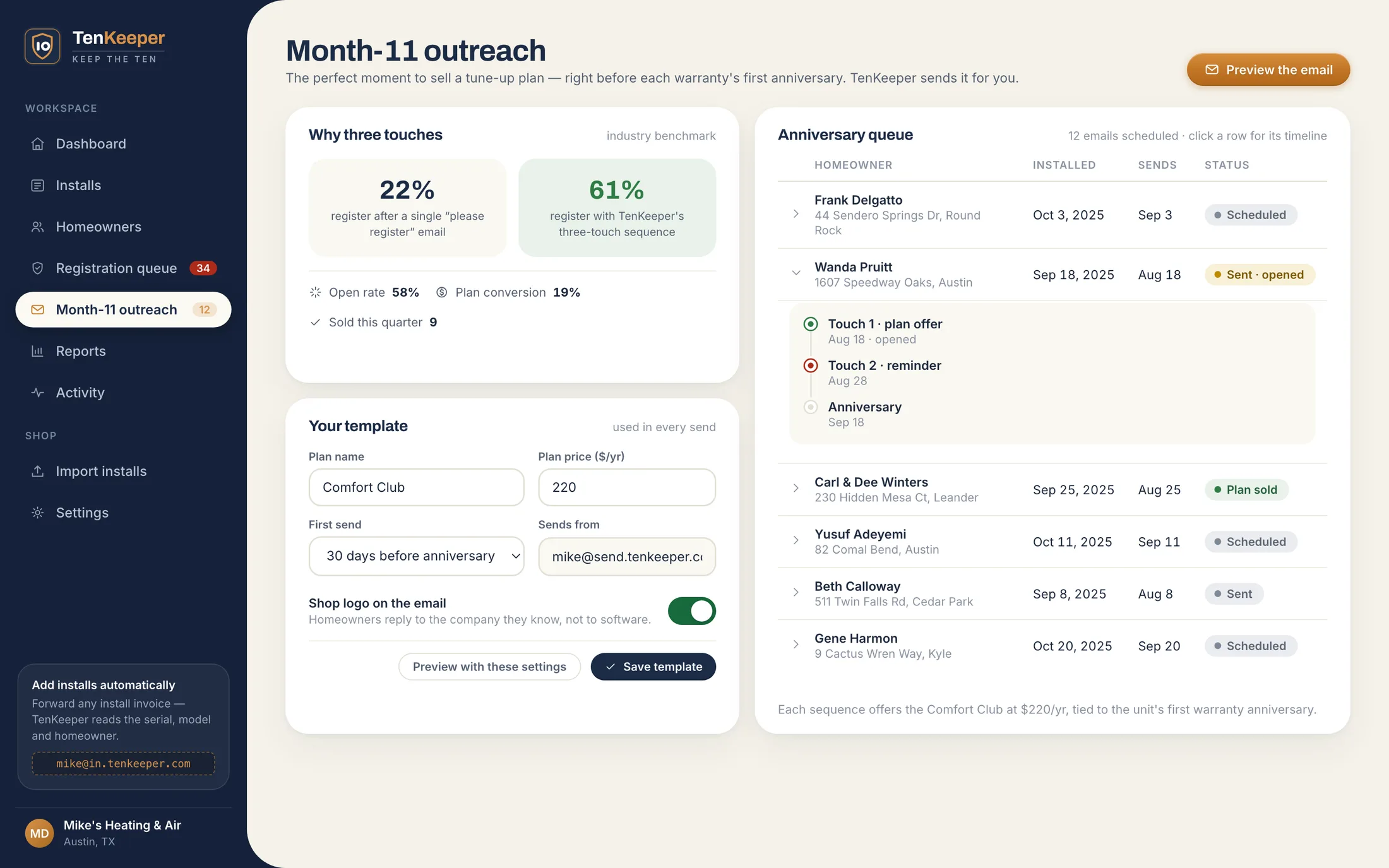
Right before each unit's first anniversary, the homeowner gets your tune-up plan offer — your shop's name, your logo, your price. One reminder email gets about 22% of registrations done; a three-touch sequence gets 61%. TenKeeper runs the sequence.

Coverage certificates for homeowners

After each registration, send the homeowner a branded certificate: unit, serial, coverage term, your shop's name at the bottom. It makes invisible paperwork visible — and it's one more reason the next tune-up call comes to you.

How It Works

Paperwork in. Proof and revenue out.

1

Forward an invoice. That's the setup.

Send install invoices to your TenKeeper address — it reads the serial, model, and homeowner, and starts the clock on every registration window. Backlog? Upload a CSV and see every at-risk unit in minutes.

TenKeeper homeowners list with coverage status and maintenance-plan status for each customer.
2

Registrations get done — with proof.

Every manufacturer form arrives pre-filled and gets chased until it's submitted. Confirmation numbers are stored against the unit: proof in hand if a claim is ever disputed.

A Carrier warranty registration form in TenKeeper, pre-filled with serial number, model, install date, and homeowner details.
3

Month 11 turns into revenue.

Right before each warranty's first anniversary, the homeowner automatically gets your tune-up plan offer — your logo, your price. Paperwork in, recurring revenue out.

TenKeeper's month-11 outreach queue showing scheduled anniversary emails and a plan-sold status.

This isn't insurance. It's income.

A shop doing 200 installs a year that lifts registrations from 1-in-3 to 3-in-4 doesn't just close a liability — it opens a maintenance-plan pipeline worth roughly $28,000 a year in recurring revenue, sold at the one moment homeowners say yes: right before their first anniversary. TenKeeper works that moment for every single install, automatically.

tenkeeper.com
TenKeeper's month-11 outreach page: the anniversary queue with sent, opened, and plan-sold statuses, next to the 22% versus 61% three-touch comparison.

Straight Answers

The questions shop owners ask first.

What does it cost?

Nothing right now. Founding shops use TenKeeper free while it's built around how their office actually works. When it charges later, the plan is a flat monthly price per shop — not per user, not per install — sized so one saved claim or two sold maintenance plans covers the year.

Which manufacturers does it handle?

Carrier, Trane, Lennox, Goodman, and Rheem at the start — each with its own form layout, because each portal asks for the same facts differently. More brands get added as founding shops need them; if you install something else, that's exactly the kind of thing to email about.

How do our installs get into it?

Three ways, use any mix: forward install invoices to your TenKeeper email address and it reads the serial, model, and homeowner; connect Housecall Pro, Jobber, or QuickBooks and new jobs sync on their own; or upload a CSV once to bring in your backlog and see every at-risk unit the same day.

Does it email our customers as us?

Yes — every homeowner email carries your shop's name, your logo, and your reply-to address, and nothing sends until you've turned the sequence on and set your plan price. Homeowners reply to the company that installed their system, not to a software brand they've never heard of.

Are registrations fully automatic?

Honest answer: the manufacturer portals were built for humans, so TenKeeper pre-fills every form, chases it until it's submitted, and stores the confirmation. Where a brand allows clean automatic submission, you can turn that on per brand. Either way the office goes from hunting serial numbers to reviewing and clicking.

Whose data is it?

Yours. Your installs, homeowners, and confirmation numbers export to CSV any time, and if you leave, you take all of it with you. The tool earns its keep by doing the work, not by holding your records hostage.
Why This Exists

TenKeeper comes out of years spent building the CRM software field-service companies run their whole business on. One gap kept showing up: the warranty paperwork nobody owns — costing homeowners real money and shops their reputation, one unregistered serial number at a time.

It's being built right now with a small group of founding HVAC shops, shaped around how a real office actually works, and free while that happens. If registrations at your shop are a "whenever someone remembers" thing, we'd genuinely like to hear how you handle them today. One line is plenty.

— The TenKeeper team

A handful of founding shops. Free.

Use TenKeeper free while it's built around your shop. Your only job: tell us what's annoying.

Email hello@tenkeeper.com

Or just reply to the email that brought you here — that works too.